Female Puppy Started Biting Stuff Again
Originally Published 5/i/2011
Ouch!
I am firmly convinced that the evolutionary process made puppies adorable then that nosotros would overlook the fact that their mouths are total of razor blades—blades they do non hesitate to put to frequent utilize. Nipping and chewing rank high on the puppy parenting complaint list, and are symptoms of teething, a developmental stage associated with both human and canine infants.
Why puppies seize with teeth
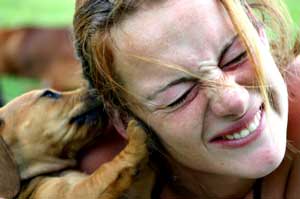
In that location are a number of reasons puppies nip, seize with teeth, and chew. This behavior starts before puppies even get out the litter—as soon as they begin to develop teeth, they begin receiving feedback on their bite strength from their mothers and littermates. With their litters, puppies learn that biting hard leads to loneliness or, worse, hunger! Bite a littermate besides hard in play? She'll likely yelp and finish playing with y'all until you've reclaimed your wits. Bite Mom too difficult while eating? You may wind up missing the snack bar as she walks abroad. Poor, lonely, biting puppies. That is, until they calm down. Then the play party is dorsum on!
Puppies also bite and nip to learn the social mores of dog culture. Dogs don't play with Legos, video games, and Barbie dolls; they chase, race, tackle, play face-seize with teeth games, pounce, tug, and wrestle. This play actually serves a more serious purpose, teaching the lessons that need to exist learned so that a canis familiaris can survive in canine society. Dogs don't communicate with exact linguistic communication; they communicate physically, through trunk linguistic communication and contact. Considering dogs don't have "wars of words," when the going gets tough, there is frequently a concrete scuffle.
When well-socialized dogs find themselves in conflict, the interaction often looks very scary—teeth flashing, growling. Generally, these interactions are cursory, nonetheless, and both dogs walk away without injury. It'southward a lot of rant, simply it is a highly ritualized display. If i or more of the dogs is under-socialized, though, the interaction blueprint changes and a player is likely to get hurt.
While seize with teeth-inhibition preparation begins while a pup is with its litter, training must continue throughout the canis familiaris'south life, with special emphasis during puppyhood. My domestic dog, Mokie, volition exist six this July, and we however practice bite-inhibition exercises occasionally.
This play really serves a more serious purpose, instruction the lessons that need to be learned and then that a dog can survive in canine society.
Hither comes trouble (one more reason!)
Puppies seize with teeth considering they are teething and learning to command their bite strength, and because nipping is a manner to explore and join the social life of dogs. Another reason puppies bite is because it makes exciting things happen; biting earns attention.
Biting for the reaction usually happens after the puppy enters its "forever home." The typical scene is where the family is repose, relaxing after a long day. Mom is checking her Facebook account, dad has his anxiety up watching the game, Suzy is studying, while Johnny plays Xbox. Anybody is ignoring the puppy. Tiresome.
The bored puppy muses, "How can I become this party started?" Biting oftentimes works to go attention, and then the puppy zooms effectually the room leaving a wake of torn pant legs in its path. Ignored no longer, now the entire family is looking at and touching the puppy, and "barking" with excitement (yelling at the puppy). Every family unit member has put bated what was previously interesting in order to focus on the puppy. Mission accomplished—the political party has started! Puppies are very good at preparation humans to pay attending to them.
Mouth manners for the long-term
Puppy grooming should emphasize beliefs problem prevention in the developed dog. While virtually puppy classes teach bones manners and commands like "sit down," "downward," and "settle on a mat," it is far more important to offer exercises and lessons that prevent behavior problems from occurring in the adult dog. Most of my puppy classes have a heavy accent on socialization, prevention of resource guarding, and development of bite inhibition.
Puppy training should emphasize beliefs problem prevention in the adult dog.
Dogs that are confident and comfy in their environment are less probable to bite. Advisable and extensive socialization helps dogs larn to be confident and comfortable in many different environments. Educational activity seize with teeth inhibition, controlling the pressure exerted behind a bite, helps stop a canis familiaris from causing meaning damage in a state of affairs where the domestic dog feels the need to defend itself with teeth. In that location is a difference betwixt gentle mouthing (a "nip") and a seize with teeth that sends someone to the infirmary. Bite-inhibition grooming helps puppies learn polite, gentle mouthing—and that human skin is very frail!
Before discussing techniques and strategies for addressing puppy nipping, I should clarify that nipping and chewing are symptoms of a developmental phase that may final 6 to nine (or more than) months from birth. This is not an upshot that will be stock-still in a single training session. Consistency is required throughout this puppy period, and regular attention to your dog's bite strength is a good idea even well into adulthood.
"Do" the correct thing
There are things you lot can practise to ensure that your dog develops appropriate "mouth manners."
Do expect until your puppy is at least 8 weeks old before separating him from his littermates. Puppies larn a lot of lessons about advisable social interaction, including seize with teeth strength, from their dam and littermates. Taking puppies abroad from their litters likewise early can foreclose them from learning these valuable lessons. Be wary of adopting "singletons," dogs born without littermates. These puppies miss out on a lot during critical stages of development, including essential feedback about the forcefulness they are putting behind their bite!
DO consider letting your puppy stay even longer with the breeder/litter if the breeder is doing a great job with socialization.
DO reserve your spot in a well-taught puppy form before you lot even bring home your puppy! While many veterinary professionals once recommended starting classes with your dog when the puppy reached 6 months of historic period (and completed a full round of initial puppy vaccinations), behavior-savvy veterinarians are now changing their positions. Many are at present recommending that puppies get-go in a grouping class at an early age, as immature as eight-weeks-erstwhile! Refer to the American Veterinary Society of Animate being Behavior (AVSAB) Position Statement on Puppy Socialization for more details. While about puppy-bitter is simply nipping, at that place are cases of aggression developing early in puppyhood; an experienced instructor will realize the deviation and aid you lot address the outcome promptly.
Reserve your spot in a well-taught puppy grade before you even bring dwelling house your puppy!
DO make certain that you have plenty of chew toys on hand—pressed rawhide, bully sticks, Nylabones, frozen blimp Kong products, or even old washcloths soaked in low-sodium chicken broth and frozen are all great treats. Supervise your puppy when he is enjoying his toys.
Exercise hand-feed your dog. Hand-feeding is a great fashion to improve your bond with your dog, and it offers yous lots of opportunities to exercise rewarding him for using his mouth politely! Hand-feeding too teaches the domestic dog that you are a very exciting and rewarding person to spend fourth dimension with—a bonus! Other family members should practise hand-feeding; encourage guests to hand-feed the canis familiaris as well. Of course, small children should not feed nippy puppies by hand. If there are elderly individuals in the home, they should practice this exercise last or wear light gardening gloves when practicing the initial stages of preparation. Since peel tends to thin as people historic period, there is a greater likelihood of puncturing.
Do manage and redirect. Crates and tethers are valuable direction tools. Y'all do non desire to associate crate time with punishment, so when your puppy needs to become in the crate to relax for a bit, offer ane of the chew toys you accept prepared. Doing so allows you to redirect your puppy's teething instincts to an appropriate outlet. If you are using a tether, make sure that your puppy is securely attached in an area that has been puppy-proofed. Neither the crate nor the tether surface area should brand the dog feel socially isolated (keep both in a living surface area and not in a clammy, musty corner of the basement).
DO set upwards play dates with appropriate puppies and tolerant, well-socialized adult dogs. Your puppy-class trainer will instruct you about how to select advisable playmates, read canine body linguistic communication and stress signals, and how and when to intervene if play gets out of manus.
DO make sure your puppy is receiving adequate physical and mental stimulation. Sometimes, puppies bite because they are bored and it's something to do. If information technology makes people scream, run, and otherwise "freak out" likewise, information technology'due south a real political party starter for a flippant young pup just looking for a good fourth dimension. Physical practice and mental stimulation alone volition not eliminate the nipping (maturity and preparation, however, will), only both tin can often reduce the frequency and intensity of mouthing behavior.
Brand sure your puppy is receiving adequate physical and mental stimulation. Sometimes, puppies bite because they are bored and it'due south something to practice.
Practice larn to "Be a Tree." You hardly always see dogs chasing, nipping, or biting at trees. Why? Because they're ho-hum—they don't move, squeal, run away, scream, give eye contact, or push the dog abroad. Trees are only at that place. "Be a Tree" is a technique that all family members should learn, but it is especially wonderful to teach pocket-sized children. Contact Doggone Prophylactic to learn more virtually the "Exist a Tree" program and to admission some wonderful canis familiaris-bite prevention resources.
Practice requite a canis familiaris binary feedback on bite strength. Adequate utilise of teeth is rewarded with treats, attending, affection, or any the domestic dog likes. Unacceptable use of teeth results in redirection (chew on this in your crate for a while) or negative punishment/removal of opportunity (bitter makes people walk away from you). For puppies that go on to chase and bite at you when y'all motility away from them, the tether can be especially helpful. Only walk out of the tether area, cross the room, sing a poetry of your favorite vocal in your head while ignoring your puppy, and then return to begin a new training session. Information technology is essential that this removal of opportunity is unemotional and that it happens instantly and consistently as a response to using unacceptable bite strength.
DO teach your puppy to use his oral fissure politely. There are many of great resources on the internet and several dissimilar techniques you tin can apply. As with all puppy training, work in brusk sessions (average 10 treats per session). Here are some of my favorite preparation exercises:
- Teach hand-targeting and/or put "kisses" on cue. These are great new behaviors for your dog to learn, simply besides teach an appropriate mode to interact with hands that can earn reinforcement opportunities!
- Play "I'm ok with that." This idea comes from one of Karen Pryor's articles about dealing with puppy nipping. Information technology'southward my favorite way to railroad train bite inhibition.
If your puppy bites your manus hard during whatever of the exercises, stand up, turn your back on the canis familiaris, and walk away or "Be a Tree." Consider practicing when your domestic dog is tethered so he cannot chase and nip you.
Soft-rima oris shaping
Ian Dunbar has a categorization system for ranking the severity of canis familiaris bites. The scale may look a little dissimilar for a young puppy without severe aggression but with a normal nipping problem. Here'due south a sample 5-category scale for that situation, with 1 existence the to the lowest degree corporeality of pressure exerted, 5 the maximum pressure.
- The puppy sniffs or licks the hand.
- The puppy gently mouths the skin. You can feel teeth without pressure.
- Moderate mouthing. Slight pressure level is applied to peel, merely not enough to cause any puncture or tear.
- The puppy bites difficult enough to cause pain, merely does not break the pare
- The puppy bites hard enough to break the pare.
There could be additional levels of biting beyond v (the puppy tears the skin, the puppy repeatedly bites the skin, puncturing it, the puppy bites and shakes the paw, etc.). If your puppy is biting at level five or higher frequently, consulting with a qualified behavior professional immediately is not optional, but necessary!
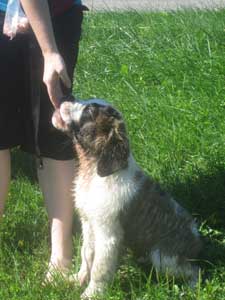
Soft-mouth shaping is another technique for teaching a puppy to utilise its rima oris politely. To start shaping a soft rima oris, place a depression-value treat in your hand and present it to your dog. Any reaction at level three or lower earns the puppy a click and the opening of the hand; the dog is fed from a flat palm. A level 4 reaction results in a 5-second removal of the hand (place it behind your dorsum and ignore the dog). Level v reactions result in a temporarily lonely puppy—walk abroad from the canis familiaris for 7 to 10 seconds before reengaging him in training. Every bit the puppy develops better command over his mouth, increment criteria and so that simply level 2 or level 1 responses earn reinforcement.
Mouthing manners: helpful hints
- Innovate movement. It is one thing for a puppy to ignore a stationary hand, but it is much harder to avoid chasing and biting at moving objects. Introduce motility of hands and other body parts slowly while practicing these exercises. If at any indicate your domestic dog becomes overly angry by the electric current level of movement (a vi-inch moving ridge of the hand in either direction, for instance), reduce the level of movement (a wiggle of the fingers or a three-inch moving ridge of the hand, maybe). Reduce move until your dog is more settled and equanimous, so raise your criteria slightly again.
- Some dogs are more inclined to bite ankles than hands. If this is truthful for your puppy, teach your dog to play with a tug at your side. Redirecting the canis familiaris'due south natural tendency to hunt and bite at things keeps your pant legs prophylactic and builds not bad toy drive, a valuable conditioned reinforcer for many dogs!
- Yous can also attempt tethering your dog and practicing impulse control exercises. Secure your puppy to a strong and stable tether. After asking him to sit, begin clicking and treating for maintaining the position while you shift your weight from your left to right leg and back. If the domestic dog is able to remain sitting while y'all do this, slowly brainstorm to introduce larger movements, lifting your right leg and shaking information technology a scrap, for instance. Gradually increase your criteria so that you lot are able to run past your canis familiaris, jump upward and downward, or moving ridge the hem of a flowing skirt in his face while he sits politely, waiting for reinforcement. If at whatsoever point in the game your dog becomes overly angry and nippy, reduce your criteria to the last point at which he was successful and consider splitting your criteria into smaller steps before proceeding.
- Practice initially with low-value treats. Once you complete the training steps with low-value treats, slowly begin introducing treats or toys of higher value. When you introduce a new or more heady reinforcer, temporarily reduce criteria and go back to the showtime step. Don't be surprised if your puppy becomes "nippier" temporarily when you introduce each new college-value reinforcer. A puppy may take kibble politely 100% of the time, but all the same snatch with his teeth for a coveted bit of roast beef. These setbacks are just a temporary office of the learning process; each fourth dimension you introduce a new reinforcer, your dog should proceed from bite to polite more speedily than with previously introduced reinforcers. The dog is get-go to generalize the skill of generalizing!
- After yous take practiced with a number of treats and toys, try altering your delivery. Present an open palm with the reinforcement initially. Many puppies will not seize with teeth an open up palm, but will seize with teeth at a slice of food clasped betwixt the thumb and index finger. When you are set, movement on from the open-palm approach to practicing all of the mouthing exercises holding the treats between your fingers.
- When you deliver the care for to your canis familiaris, be careful not to jerk your paw abroad chop-chop, as this can elicit a hunt response. Instead, move the care for toward your dog'south mouth rather than having him snap at your rapidly retreating hand. Employ a cheap pair of gardening gloves in the initial stages of preparation if your hands are very sensitive!
Worth the effort
While training your puppy not to nip or bite may sound like a lot of work (and, to be fair, puppy-raising is definitely a lot of piece of work), it is one of the virtually important things you lot can teach your dog. Seize with teeth-inhibition training saves lives; it helps dogs and people stay rubber together and enjoy each other more than thoroughly.
Bite-inhibition training saves lives.
Puppy grooming should focus on preventing behavior problems in the adult dog—and no beliefs problem is more than unsafe for dogs and people than biting. Any dog may bite if it senses danger, feels trapped, or experiences pain, amid many other reasons. Early on and extensive bite-inhibition training provides the confidence of knowing that if your domestic dog always finds himself in a provocative state of affairs, it's significantly less likely he will crusade serious damage with his teeth.
Well-nigh the author

Casey Lomonaco lives in upstate New York, where she offers editorial, writing, and beliefs consulting services through her visitor Rewarding Behaviors Dog Training. When she is non working with or writing near dogs, she is knitting, reading, or hiking in a forest—with dogs.
Source: http://www.clickertraining.com/how-to-survive-puppy-teething-and-nipping
0 Response to "Female Puppy Started Biting Stuff Again"
Post a Comment